Showing posts with label florida. Show all posts

Oct 7, 2016

How to paint a Hurricane

Hurricane Evacuation

Yesterday, I quickly packed to evacuate my island home and run from Hurricane Matthew. Hurricanes are scary. I grabbed a stack of art books to pass the time as I sit in my comfortable hotel room in Orlando while the storm passes.

Painting the Elements

So my best hurricane book is "Painting the Elements" by Kelly Messerly. She encourages us to analyze weak design and fix a bad painting. There are basics -- color, contrast, composition, and design, as well as sunlight, shadows. And very useful for me today is the chapter on clouds, mist, rain...

So how do you paint a hurricane?
  1. Use great design and color. 
  2. Understand how to paint.
  3. Most of all, live it.

Living the Hurricane

While I can't really go out to paint plein air during the hurricane, I'm watching the swath of destruction on TV. I'm sketching while viewing through the window how the palms are blowing sideways (even in Orlando we're experiencing hurricane force winds).

I'm actively worried about how my house and gallery are faring. I'm eating too many snacks. I'm feeling this storm. It's personally affecting me to my very bones. Totally a way to create a meaningful "worried" point of view on canvas. I can't even think straight enough to paint, but I'm sketching and I'll eventually take the sketches to create paintings of dark, moody, and scary.

Stay dry!

--Mary Hubley


Jun 30, 2016

Distractions in Plein Air Painting: At the Carousel


Plein air painting includes many distractions - usually it's the cold, wind, heat, insects, and rain. But on this perfect June day at the carousel, little did  I know there would be different distractions than Mother Nature.


When I arrived, I toured the grounds to decide what to paint. There was, of course, the carousel. Front and center. This vintage piece of childhood goodness is a bit overwhelming to paint. Lots of detail. Way more red than I'm used to painting in a landscape. And it moves.

So... I considered alternatives. - there were trees. Everywhere. And children. Hmm. But the carousel would not let me avoid it, as much as I tried.

"You can't paint me - I'm too complicated for you,"  it teased.

I stood there and took a breath. I studied the structure. Hmm. I plunged into the carousel's challenge.
 
I started in on painting the carousel. My friends in the Anastasia Plein Air group joined me.


That's when the distractions arrived. Children. Running, jumping, yelling, throwing things. I ignored them and continued to paint.

They noticed us. They approached. Watched.

One said, "Hey, you're a good artist."

"Thank you," I replied.

A little boy took a fancy to me. He told me he was four. He reached out, picked up a brush and played with the bristles. He took a critical look at what I was doing and gave me pointers.

"You should put a kid in that painting," He said. "And other people."

"Thank you. I will."

He looked up at the carousel and squinted. "It should be redder," he continued.

"You're right. . . Are you an artist?" I asked.

"Oh, yes," he assured me. "I'll paint after lunch. I like blue."

What a super-welcome distraction. A delight. Refreshing. I took the boy's advice and added a kid, and made some deeper reds in the carousel. Best advice I've gotten in a long time.

-- Mary Hubley


May 14, 2016

Painting Demo: St. Augustine Lighthouse

This is what I painted during a recent plein air day in St. Augustine by the lighthouse. I've taken progressive snapshots of my painting process, below:


Above - here's the location where I'm painting - I'm on the beach at the St. Augustine Florida lighthouse, next to a big wide palm tree. In the foreground is my paint box and where I've set myself up in front of a lovely sailboat. Below, you see a close up of the very beginnings of my painting - here, I've done the initial drawing, added a few greens, and blocked in the darks:


It's about a half-hour later, and I've added the blue of the sky, a few pops of red, and have started to bring in some textural detail in the foreground.


And below is the finished piece. I've added the rest of the detail in the plants. I also added more paint, and at the very end created the lightest lights and redefined the darks:

"Palm by the Lighthouse" 8 x 10, Mary Hubley

To see more of my paintings, go to www.maryhubley.com.

I'll be posting more of these painting demos soon! Thanks.

--Mary Hubley

Apr 29, 2016

Plein Air Season in Florida

Plein Air season in Florida is just about over - another month or so before it gets too  hot to paint outside and once again I'll relegate myself to the cool cave of my studio. I have amassed many small plein air studies I'll use as reference for my larger studio paintings.


Painting Tree-Fort - photo of fort.

Final Tree-Fort Plein Air Study - subtleties are glowing.
I find that a season or two of plein air has brought me deeper into my art. Colors have appeared this year on my canvases that I've never spent much time with before - more purples, deep blues, and non-browns. Working only from photographs is limiting, and I'll never go back in that direction again. Sure. photos are great for reference. They provide you with a good basis for initial sketching and setting up composition. But snapshots don't capture color well - you can't see the purples in deep shadow, or the vibrancy of blue in the sky, or nuances in a green landscape.

It seems that plein air painting draws me out a few times a month. I go with my plein air group, Anastasia Plein Air, and join up with the Flagler plein air group as well. These take me all over the region, painting along back sandy roads, boat yards, and cobbled streets of the old city in St. Augustine, Florida.

Photo taken of Mary Hubley by St. Augustine Record during the National Park paintout in April 2016.
Last month I did two week-long paintouts. There was a National Park paintout celebrating the park system's 100th anniversary. I was asked to give the demo for the event, and I found my picture and an interview on the front page of the local paper. Then I won second prize at the Flagler Plein Air paintout. Yay! 


Next month, in May, the beginning of summer heat, I crazily have seven plein air dates scheduled, including two paintouts. A last hurrah before true blistering summer.


Sep 3, 2015

Painting Authenticity in Historic Places

White Window by Mary Hubley
White Window (c) Mary Hubley

St. Augustine History

I live in old St. Augustine, Florida, a place that abounds with historic colonial Spanish, French and British sites. There are grand Victorian hotels, a couple of authentic old Spanish forts, and a tall black and white spiral lighthouse. The maze of ancient homes on old-world streets is an artist's dream.

Yesterday, friend Wendy and I did a photo shoot of hidden St. Augustine. We trekked the hidden cobbled streets that most people never see. We took photos of the private gardens, dark shadows of mossy walled courtyards, and secret alleyways. I've lived here for 20 years, and I still find places that are new wonders waiting for me to paint.

Use Photos as a Reference

Yesterday's photos will become references for some new paintings. I'll sort them to find the most promising. I'll make a few sketches. Then, I'll finally go back to the best places later on, and reconnect in person with pencils and paints. I'll sit there for a few hours to do some plein air painting. You can't get any more authentic than sitting and painting right at the source of the inspiration.

When painting a historic site or a recognizable place, you need to consider everything - perspective, color, contrast, composition, just like in every other painting.

St. Augustine Lion (c) Mary Hubley

Authenticity

There's one big difference, though, when painting something everyone recognizes: you need to be authentic. Paint everything that's there - even the seemingly insignificant things. Keep in all the messy stop signs, telephone lines, trash cans, and mailboxes. Why? Because it's authentic. It's a part of the historic fabric of a famous landmark. And, removing ugly details from a well-known place will be noticed. People will pick apart the details and judge your painting by all the wrong reasons.

I actually like the messy little details. They add character to the piece. They're authentic.

You can sometimes make slight changes, though. Move a trash can a bit. Downplay contrasts, deaden a color. Or if all else fails, hide an intrusive object behind overgrown grass, a car, or a passing pedestrian.
 

Mar 11, 2015

Ready, Set, Action: On Location with a Film Crew

Plein air painting on St. Augustine Beach
Plein Air Painting on St. Augustine Beach
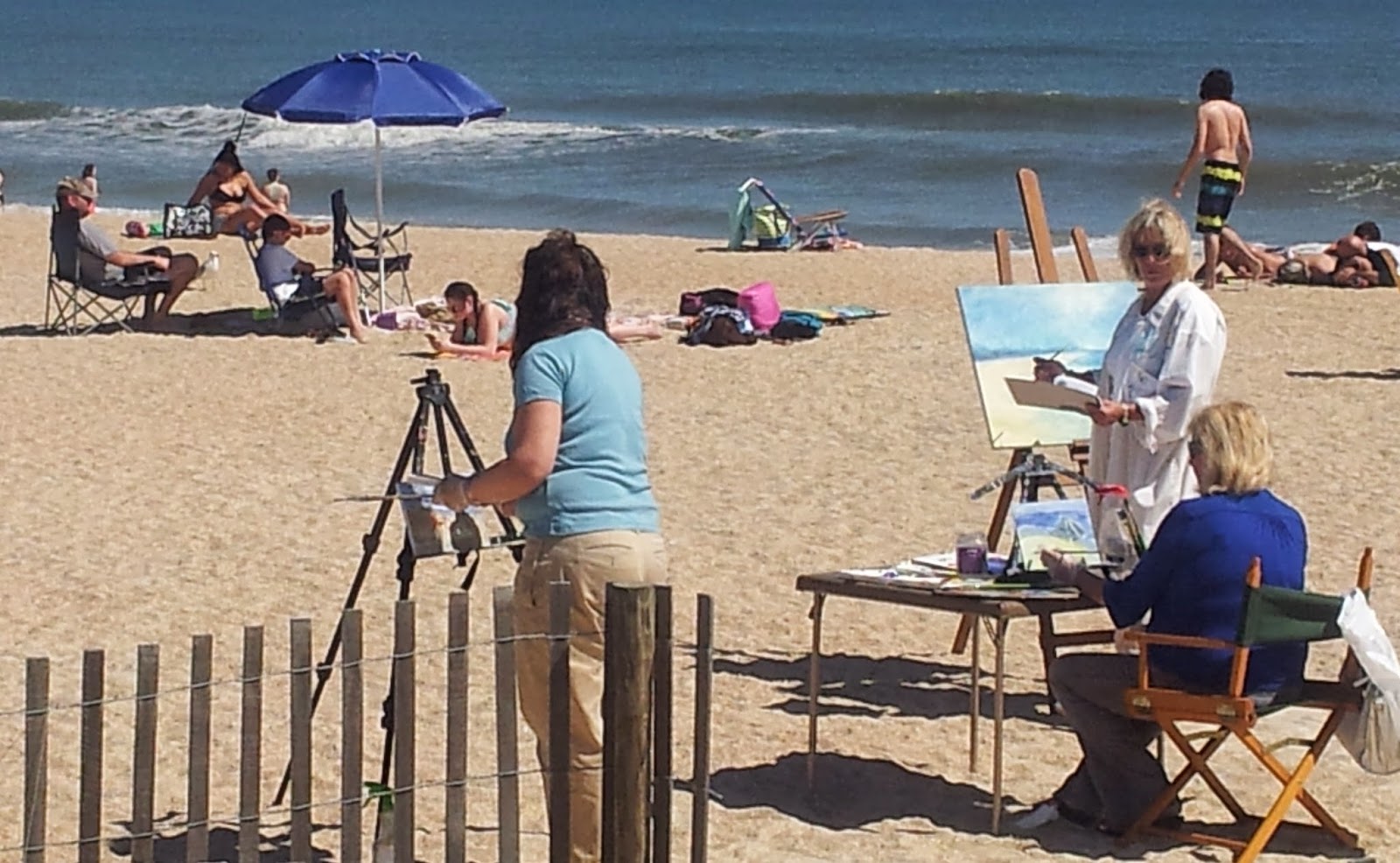
Here are a few photos from a very special plein air painting session I taught yesterday. Special, because we were met on location by a film crew taping a promotional video. They met us on the beach to film us -- me, Sheree, Nancy, and Ellen -- painting on the beach.

The weather couldn't have been better. As luck would have it, the fog had just lifted and it turned out to be one of the first beautiful warm days of the year. The sunshine drew the sunbathers out - they were busy soaking up the rays. We painted that deep blue umbrella, seagulls, and people playing by the waves.

Close-up of Mary Hubley doing a quick study of the beach
Close-up of my quick study of the beach
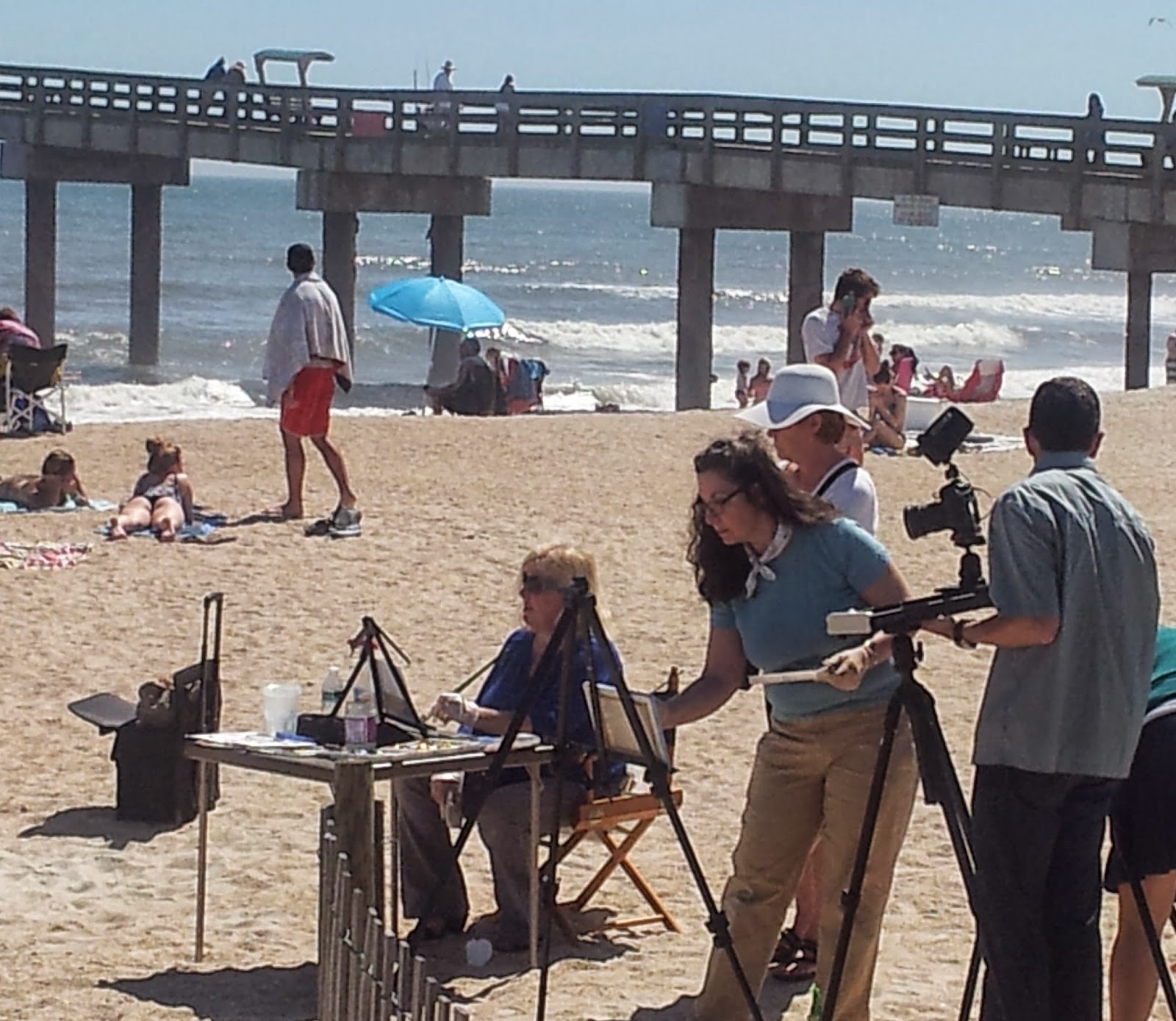
The cameras are at the right, taping us as we're painting. See the Beach pier in back of us
The cameras are at the right, taping us as we're painting. See the Beach pier in back of us.
As we painted, we moved, we stopped, and we started on queue from the filmographers. They took views of us as a group, with the luscious blue sky and bright beach backdrop. Then they moved in for some closeups of my hand adding paint to the canvas, scanning out to the scene I was capturing in front of me. Eventually, the film is intended to be part of a promotional video for the St. Johns County Cultural Center.

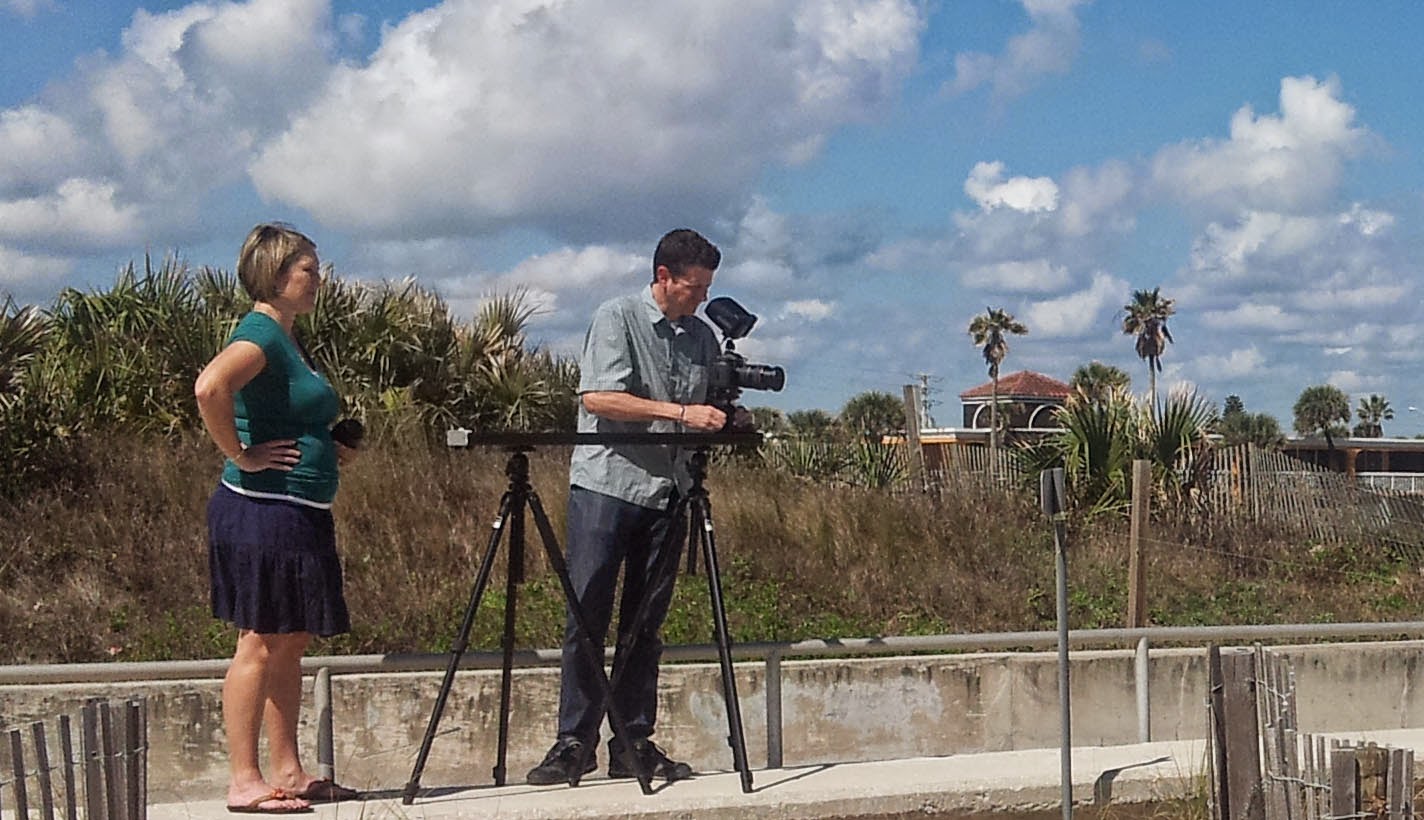
Janice and Donald Jones, our videographers from CycleHereMedia
It was fun! Thanks so much, Janice and Donald Jones, our videographers from CycleHereMedia! Hope the day's filming makes it to the final cut!

--Mary Hubley
www.maryhubley.com

Nov 17, 2014

Installation of Beach Bike Painting

Bicycle on the Beach
Beach Bike (c) Mary Hubley
Beach Bike was a wonderful commission painting, which I installed in a private home last week. The new painting happily sits in the new owner's guest bedroom, overlooking the Atlantic Ocean.

I started the project by preparing a mood board, which matched a basic photoshopped photo of this scene to the colors and patterns around the room. The key colors were coral, beach sand white, and sage green, and you can see some of the patterns that were on the pillows, above. I painted the bicycle in the coral colors, and interspersed these colors in the sage and white dunes. The bike sits against a sand dune fence, and the grassy dunes are in the background.

It was remarkable to see the painting installed. View the painting and turn your head to the windows on the left, and the colors perfectly matched the home's beachfront and dunes.


Beach Bike (c) Mary Hubley


Beach Bike Installation
33" x 44"
Oil on Canvas
SOLD

--Mary Hubley


Nov 10, 2014

Painting Workshop in St. Augustine

Painting at the Fatio House in St. Augustine Florida
A beautiful day in November! My painting workshop was held at the Fatio House in downtown St. Augustine, in a large garden surrounded by 18th century buildings. Here, I'm working with my workshop students as they're working their way through their paintings.

Second painting of the day! Painting Workshop


I generally do a quick demo for my students in a workshop, showing them how do do the underpainting and then applying blocks of color. Then, I move between them as they're working, offering hints and suggestions.

At the end of this day, we walked over to GNG Gallery, which is just around the corner, and took these photos of the day's work:

Painting workshop with Mary Hubley


--Mary Hubley

Oct 29, 2014

A New Way to Think About Painting Still Life

Moonshell painting by Mary Hubley
"Moonshell" (c) Mary Hubley

Still Life = Boring?

Still life means Still. Dull. Mundane. A bowl of boring fruit... A vase of dead flowers. Sigh. Poor still life. What a wretched reputation.

But I still believe. I hope my still lifes accomplish energy. I try to animate the still objects that I pick up on the beach. Seashells are energized with light and color. Flowers are explosions of composition, mood, and light.


Here's how I switch the mundane still life to extraordinary:  
  • Connect with the subject. I paint things that mean something. Combine Grammy's old bowls and fresh cut oranges. Those oranges smell great. Happy. Paint the memories. 
  • Treasure hunt. Go to the beach and find a pocket of the shells, stones, and sea glass. Get in the car on Saturday for a couple hours of garage sales.
  • Set it up. Experiment. Move things around for an hour or two before you get started. Go for unusual angles. Make objects go off the page. View from above or underneath.
  • Contrast. Use strong lights and shadows. Place a shiny object next to something furry; something organic against something man-made. Place patterns in the background.
  • Practice, huh? Getting good means you need to do it. Jump in.

This painting is available - please contact Mary Hubley for details.
 
Genre: Still Life
Painting Name: Moonshell
Size: 6" x 6"
Media: Oil on Canvas


Mary Hubley
www.maryhubley.com

Oct 16, 2014

Secrets to Painting Palm Trees

Palm Trees on Blue by Mary Hubley artist
Palm Trees on Blue (c) Mary Hubley

Palm Tree Paintings


These two little lovelies are just outside the studio where I teach painting classes (The Art Studio in St. Augustine Beach, Florida). These sabal palms are unsuspecting models for my art students.

On Painting Palm Trees

They're about the worst models I've ever dealt with. They're unruly, weird, and unforgiving. Kind of like the Twiggy of the tree world, palms look like shaggy lollypops rather than "real" trees. But we soldier through them, because it's all we have.
  • Tell yourself they're not really trees at all. Treat them like they're merely shapes, with shapes within shapes within shapes.
  • Not all palm trees are equal. Different varieties - sabal, fan, alexander, date, royal - look different. You can't figure one out and be able to paint all of them the same way.
  • Start. First paint the shape -- lollypop.
  • Continue. Paint darks and lights. Set apart a few main branchie-leaf-things. Finish with a few long, thin lines to detail the leaves and trunk. 
  • Back-paint around the leaves with the background sky.
  • Be patient. It took me a few years to really get comfortable painting palms. They can take much more time to do than other trees, especially at the beginning.

Genre: Landscape
Painting Name: Palm Trees on Blue
Size: 10" x 8"
Media: Oil on Canvas


-- Mary Hubley

Sep 9, 2014

The Challenges of Painting Butterflies

White Butterfly Painting by Mary Hubley
Butterfly (c) Mary Hubley

White Butterfly Paintings

Butterfly and Lavender painting by Mary Hubley
Butterfly and Lavender (c) Mary Hubley
The Florida marshes hold many small treasures -- lovely creatures like these white cabbage butterflies. Sweet insects with white fairy wings.

Trying to paint a butterfly is impossible. They move too quickly.

To get them, I'll do plein air sketches. I'll sit in the middle of flowers and draw. I'll watch them as they move around. I'll do a few quick gestural drawings. I may pull out my colored pencils to grab some of the color.

White butterflies aren't white - there are many colors. Lots of reflected color - notably green in a green field. But also the flower colors they are surrounded by - yellow,  purple or red..

Before I leave, I'll take photos so I can do the actual work of painting in my studio. While my studio isn't as gorgeous as being in a field of flowers with butterflies surrounding me, I draw from my experience of the day to create the memory.

Genre: Animals
Painting Name: Butterfly
Size: 6" x 6"
Media: Oil on Canvas


Genre: Animals
Painting Name: Butterfly and Lavender
Size: 6" x 6"
Media: Oil on Canvas


 -- Mary Hubley

Sep 3, 2014

White Pelican Painting

Oil painting of white pelican
White Pelican (c) Mary Hubley

White Pelican Oil Painting

The Florida landscape enjoys its pelicans, flying down the beach in formation, dipping into the surf to catch a fish, and sitting around the boat yard looking for handouts from fishermen who bring their catch ashore. This pelican was perched on a dock piling, waiting for the days' catch to appear.

This pelican painting almost painted itself - the sky was a perfect dark ultramarine blue, which made the whites in the pelican and the clouds stand out.

Genre: Animals
Painting Name: White Pelican
Size: 6" x 6"
Media: Oil on Canvas


-- Mary Hubley

Aug 21, 2014

Eagles Nest

Eagle in its nest
Eagle's Nest (c) Mary Hubley

A Bald Eagle Nesting

My friend took a photo of this eagle nesting in a high tree, and I based this painting on it. I was struck by its powerful pose, the texture of the nest, and the vivid blue.

Genre: Animals
Painting Name: Eagle's Nest
Size: 12" x 12"
Media: Oil on Canvas

Aug 18, 2014

Cummer Museum Oak Tree

"Cummer Oak" (c) Mary Hubley

Cummer Oak

This sprawling live oak tree is at the Cummer Museum, in Jacksonville, Florida. Underneath it are the museum buildings and garden. Massive branches reach to the ground. People meander underneath, in the deep shade. The painting is a show of light and shadow. The canopy features cubes of greens, making light dance off of the canvas.

Genre: Landscape
Painting Name: Cummer Oak
Size: 16" x 20"
Media: Oil on Canvas

Aug 13, 2014

Florida Butterfly

Gulf Fritillary or Passion Butterfly
Butterfly Meadow (c) Mary Hubley

Paintings of Butterflies

I looked over yesterday as I was in the garden to spy a colorful flitting of wings breeze past my head. I watched the small orange and black butterfly stop to enjoy the yellow flowers at the edge of my yard.

Living at the beach means you get to see all kinds of wildlife, from gopher tortoises to manatees. We have an abundance of hummingbirds and a few eagles and at least 100 different varieties of butterflies. I thought this might be a monarch, but I looked it up. It's called a Gulf Fritillary or Passion Butterfly.

Genre: Animals
Painting Name: Butterfly Meadow
Size: 8" x 8"
Media: Oil on Canvas


--Mary Hubley 

Jul 2, 2014

Mystified by Painting Palm Trees

three palm trees
Triple Palm (c) Mary Hubley

Just Mystified.

Painting palm trees has always confounded me. Where I grew up in Philadelphia, trees were not spiky. Northern trees make sense to my mind. Southern trees are maniacal.

For the past 20 years, I've lived amongst the palms. I've sat and studied them. Still confounding. A basket-like bulge at the top holds a bouquet of blades like a messy teenager's hair, all pointing in an array of distractions.

The Structure of the Palm

In this painting, I tried to make sense of them. I watched them wave in the wind. I listened to them rustle and saw them change as the sun popped in and out of clouds. I painted. Blue sky, green palm-tops dancing in the wind.

What's the secret? 

Here it is: to really see them. Squint. Close one eye. Magic!

The complexities disappear. They are reduced to darks and lights. Paint that simplified version.


Genre: Landscape
Painting Name: Triple Palm
Size: 10" x 8"
Media: Acrylic on Canvas


-- Mary Hubley


Jun 5, 2014

Cross Creek

Palm trees at Cross Creek Florida
Cross Creek (c) Mary Hubley

Adding Vivid

I've started using more vibrant blues in my paintings recently. The pop adds drama to a soft painting.

This painting was done at Cross Creek, Florida, home of legendary Pulitzer-prize winning author Marjorie Kinnan Rawlings. She's the author who wrote The Yearling and Cross Creek. The place is in the middle of Northern Florida, and still looks pretty much the same as it did in the 1930s and 1940s when she lived there.

These tall palms struck me - they're reaching deep into the blue sky, above the cloud line and humidity that hugged the horizon. Rawlings' home at Cross Creek sits at the base of the palm trees.


Genre: Landscape
Painting Name: Cross Creek
Size: 8" x 10"
Media: Oil on Canvas


-- Mary Hubley

May 29, 2014

Using an Artist Viewfinder


 Painting Large Spaces


It's not all that easy to stand there, at the edge of the surf, and consider doing this as a small painting. You're looking at large things - a great blue sky, long beach, and immense ocean. Vastness is intimidating. Many of my art students are too overwhelmed with the expanse of ocean, surf, and beach to try to capture it at all, yet alone doing it on a small canvas. It's just too big.

ViewCatcher But it doesn't have to be intimidating; there is one trick that makes this do-able. When a landscape is too big, I use a viewfinder to quickly figure it out.

Using an Artist's Viewfinder

An artist's viewfinder is kind of like using a camera lens; you hold it up to the subject, squint and look through one eye, and move it around until you frame the perfect composition. Instead of taking a snapshot, you paint what you see through the viewfinder.

With this painting, I used my viewfinder to crop out much of the sky and the ocean, making the beach the largest element in the foreground. I could have done the opposite - cropping off much of the beach, leaving a great blue sky and larger body of water. I liked this view better.

--Mary Hubley

May 19, 2014

The Problem with Painting From Photos

When the weather is perfect in my wilderness, outdoor plein air painting is soul filling. Sweet air and perfect temperature, I hold my palette in one hand and a hot cup of coffee in the other.

However, Florida weather is hardly idyllic. I avoid the marshes when dog-sized mosquitoes swarm and soaring heat gives way to hard rain. When the outdoors are at their most ferocious, I stay in my studio and paint using good references.

Photographs As Painting References

Photographs copy a scene's shapes, distances between objects, and contrasts. They're adept in capturing a moment in time like a wave breaking, a person walking, or a bird in flight. But they're really bad at one thing --  color. Photographs don't show reality's true hue, depth, value, or saturation. Shadows are the biggest problem; photographs just don't get the dark, rich details that your eye sees in real life.

Use Sketches 

I still use photographic reference. But I don't rely on them alone. I also do a couple of colored pencil or acrylic sketches that I'll take back to the studio.

Small sketches get the color. But they do so much more. Quick sketches capture freshness. They're like little shorthand notations for what I feel about a scene. They capture vibrancy, joy, peace, solitude, or whatever it is that makes my heart sing when I first lay my eyes on a scene. They're my impression, which I find is most important in creating a painting that's full of life.

Photo reference may create paintings that are technically perfect, but they're never very exciting. Sketch references are the answer to adding luster and life. 

Keep painting!

-- Mary Hubley

May 12, 2014

Paint Out St. Augustine

Paint Out St. Augustine
St. Augustine Aviles Street (c) Mary Hubley
During St. Augustine's Romanza Festival this past weekend, I was one of the lucky plein air artists invited to paint along Aviles Street.

My spot had a perfect view of the historic Fatio House. At the Fatio house, you can take tours to view colonial Spanish life.

The early morning light hit the front of the white building and palm trees. The early sky was still quite blue, not yet giving into the gray-white of later morning humidity. The breeze rustled the palm leaves. People stopped by to view my progress.

I painted until noonish, when I took a short break with other artists for lunch - how could I resist? The street is lined with quaint cafes offering cold iced tea and fresh salads. Later, I got back to work and finished. Here, I am holding my plein air painting at the end of the day.


Genre: Landscape Painting
Name: St. Augustine Aviles Street
Size: 10" x 10"
Media: Acrylic on Gallery Wrapped Canvas


-- Mary Hubley